Skip to content

“We Cannot Reckon How Great the Damage Is”: Origins of the Transatlantic Slave System, c.1450 - c.1650

Discussion of how to teach the origins of the transatlantic slave system with a focus on understanding the different regional and global consequences

Bram Hubbell
Bram Hubbell
13 min read
“We Cannot Reckon How Great the Damage Is”: Origins of the Transatlantic Slave System, c.1450 - c.1650

Considering that the transatlantic slave system existed for more than 400 years, it helps students learn how it changed and evolved. Looking at the number of enslaved Africans imported into the Americas, it quickly becomes apparent that there was a numerically smaller phase before 1650 and the numerically larger phase after 1650. The disparity in the number of enslaved Africans reflects the reality that it was mainly the Portuguese and, to a lesser extent, the Spanish involved in the transatlantic slave system before 1650. Many more Europeans began to participate in the system after 1640, which led to the rapid growth in the number of enslaved Africans that Europeans forcibly transported to the Americas. Between 1450 and 1650, the Portuguese established in Brazil the basic model of the plantation system that became common throughout the Americas. The Portuguese significantly affected the economic, political, and social structures in the parts of Africa they operated, as well as affecting the rest of the Atlantic World.
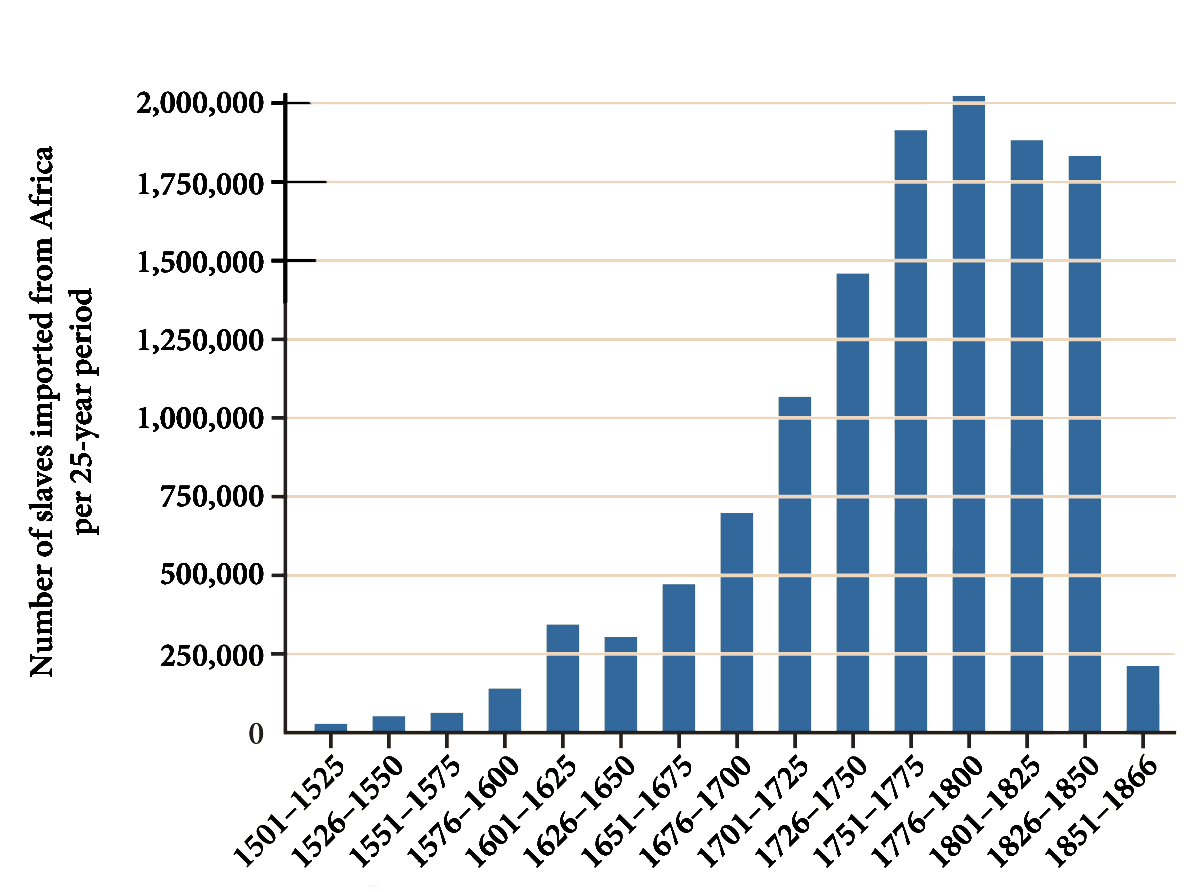
Enslaved Africans imported to the Americas from 1501 to 1866. https://commons.wikimedia.org/wiki/File:Graph_of_the_Number_of_Slaves_Imported_From_Africa.png

Formation of the American Plantation System


Related Posts

Members Public

“Our Uzbek History is Tied Up with Cotton”: Cotton in Late Imperial Russian and Soviet Central Asia

Teaching Russian and Soviet Colonialism

“Our Uzbek History is Tied Up with Cotton”: Cotton in Late Imperial Russian and Soviet Central Asia
Members Public

“Leading Russia Nearer and Nearer to Utter Ruin”: Teaching the Russo-Japanese War from a Global Perspective

Reframing how we teach the Russo-Japanese War

“Leading Russia Nearer and Nearer to Utter Ruin”: Teaching the Russo-Japanese War from a Global Perspective
Members Public

“On Arrival at the Market with their Grain”: Grain and Mass Production in Late Imperial Russia

Rethinking how we teach late imperial Russia’s economic changes

“On Arrival at the Market with their Grain”: Grain and Mass Production in Late Imperial Russia