“Sables, Ermines, and Squirrel Skins”: Teaching the Fur Trade and Russia in World History
Teaching Russian history and the fur trade

Having gone to high school in the late 1980s meant growing up in the shadow of the Cold War. Ronald Reagan’s rhetoric about the Soviet Union as the “Evil Empire” shaped popular culture. Movies and TV shows regularly presented the Soviet Union and Russians as villains. Not surprisingly, this portrayal influenced how we learned about Russia in history classes. Russians were inherently bad or evil. I remember teachers emphasizing how Tsarist Russian autocracy was the natural prelude to the Communist Soviet Union. My understanding of Russia didn’t change much in college, but that was probably more because I rarely learned about Russian history.
When I began teaching world history, I noticed how textbooks sometimes portrayed Russia as one of many Afroeurasian empires. In Ways of the World, Robert Strayer made a point of comparing the Russian Empire to other Eurasian empires (the Mughals, the Ottomans, and the Qing). Despite this nod to world history, most textbooks focused on how the Russian Empire differed from Western Europe, emphasizing Russia’s eventual transition to the Soviet Union.
In thinking about how to teach Russian history today, we must avoid earlier teleological interpretations. Instead of focusing on how Russian history inevitably led to the rise of the Soviet Union, we can focus more on how Russian history reflected contemporary global historical patterns. In this first post on teaching Russia in world history, I will discuss how the Russian participation in the fur trade allows us to contextualize the development of the Russian empire and see the influence of the Mongol Empire on Russia.
Resources for Russian History
There are lots of books on Russian history - maybe too many. Figuring out where to start can be challenging, so I want to highlight three books that are excellent resources for world history teachers.
Barbara Alpern Engel and Janet Martin’s Russia in World History is the ideal introduction to Russian history. Both authors are specialists in Russian history, but they traditionally cover different eras. The book is also part of Oxford University Press’ New Oxford World History series. These short books contextualize regional and national histories in global historical patterns. In their introduction, Engel and Martin clearly emphasize how they see Russian history as more than European history:
The history of Russia is necessarily… a story of efforts to meld a multiethnic polity into a coherent political entity and… of the impact of these efforts on its various peoples. This story is, at the same time, a history of Russia in the world. Russia’s successes in overcoming its many disadvantages rested in part on its ability to draw on the cultures and technologies of its neighbors and adapt them to its own circumstances. In turn, the innovations of Russia’s peoples spread beyond its borders... Adaptation and innovation continue to drive Russia’s development and there is every reason to believe will do so into the future.
David Christian’s A History of Russia, Central Asia and Mongolia, Volume II: Inner Eurasia from the Mongol Empire to Today, 1260-2000 is not explicitly a Russian history book. It’s an Inner Eurasian history book that incorporates Russian history. We often think of Russian history as part of European history, but Christian helps us see how Russia’s connections to Inner Eurasia (Central Asia) have shaped it.
Choi Chatterjee’s Russia in World History: A Transnational Approach approaches Russian history in a unique manner. Many historians view Russia as part of Europe, but also fundamentally different. Europe was liberal and democratic, while Russia was oppressive and autocratic. Chatterjee argues that we should focus less on the differences between Western Europe and Russia and more on the parallels, especially the imperial ones:
It is important to remember that the Russian colonization of the massive Eurasian space to the south and the east commenced at roughly the same early modern period as the European explorers traveled west to the New World, and east to India and China via the southern tip of the continent of Africa, intentionally bypassing the empires of the Middle East, North Africa, and West Asia. Moreover, the Russian Empire was built in the immense Eurasian space that had been created earlier by the victorious Asian armies that traveled along the immense distances of the steppes. Rather than split the history of Europe between that of a democratic West and an autocratic East, it is necessary to integrate the Russian imperial experience along with the other narratives of world history to fully understand the emergence of a globalized world in the twentieth century. The European domination of the world in the nineteenth century was only possible because Russia’s colonization of Eurasia had helped create an interconnected and Eurocentric global world order.
Chatterjee’s arguments about the similarities between Western European and Russian Empire-building help us reframe how we think about Russia and Europe. Russia’s imperial ambitions weren’t unique. Many European states built illiberal and oppressive empires. Chatterjee’s focus on seeing the similarities in empire-building between Western Europe and Russia contrasts with Strayer’s approach in Ways of the World. While acknowledging the contemporaneousness of Russian and European empire-building, Strayer focused more on how Russia resembled Afroeurasian land empires. Chatterjee flips those comparisons on their head to emphasize how Russian imperialism was similar to European imperialism.
These three books help us rethink how we approach Russian history. Instead of thinking about Russia as a unique European state, we can emphasize how Russia, like the rest of Europe, fits into global historical patterns.
“Russia” Before Moscow
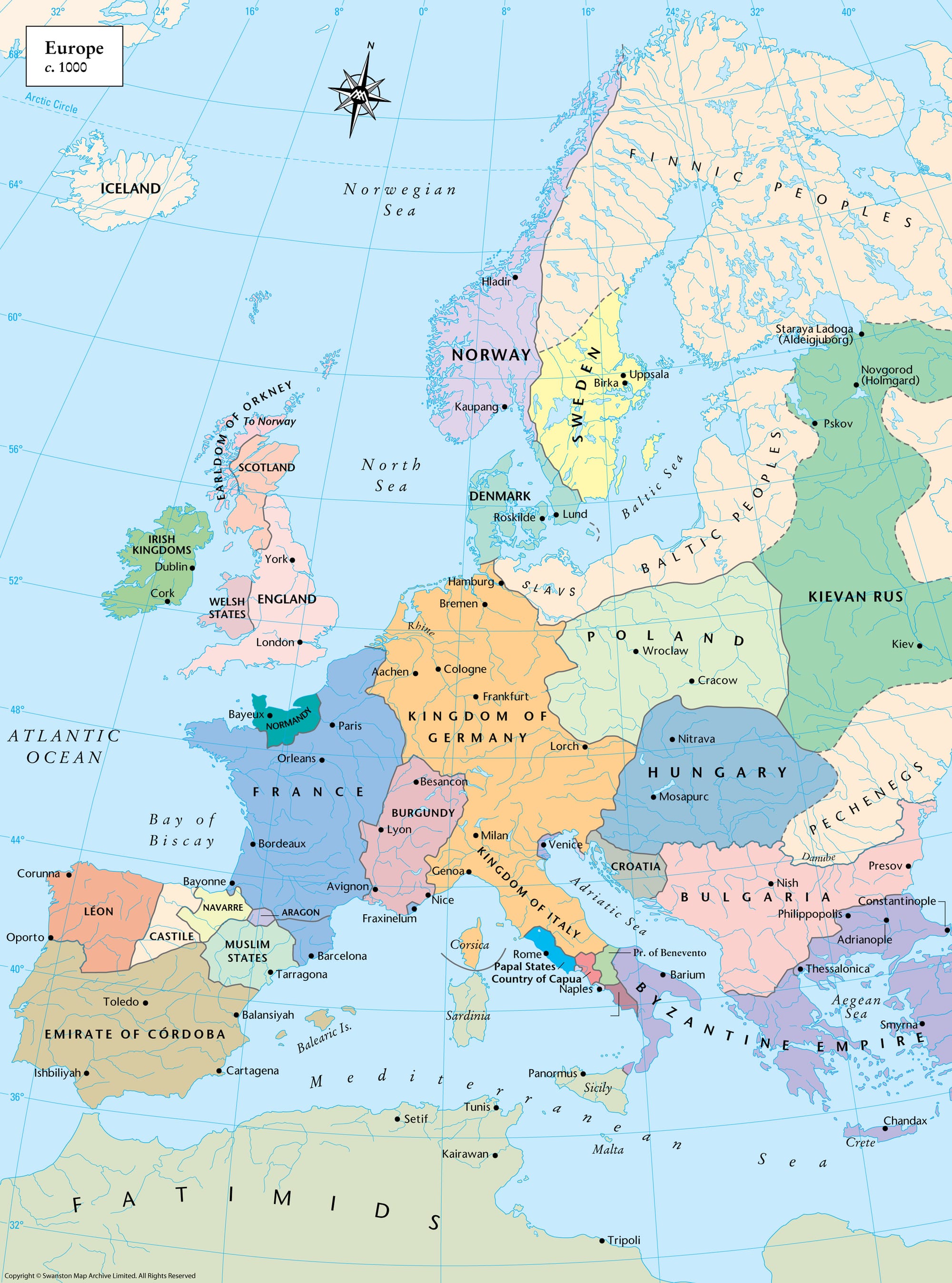
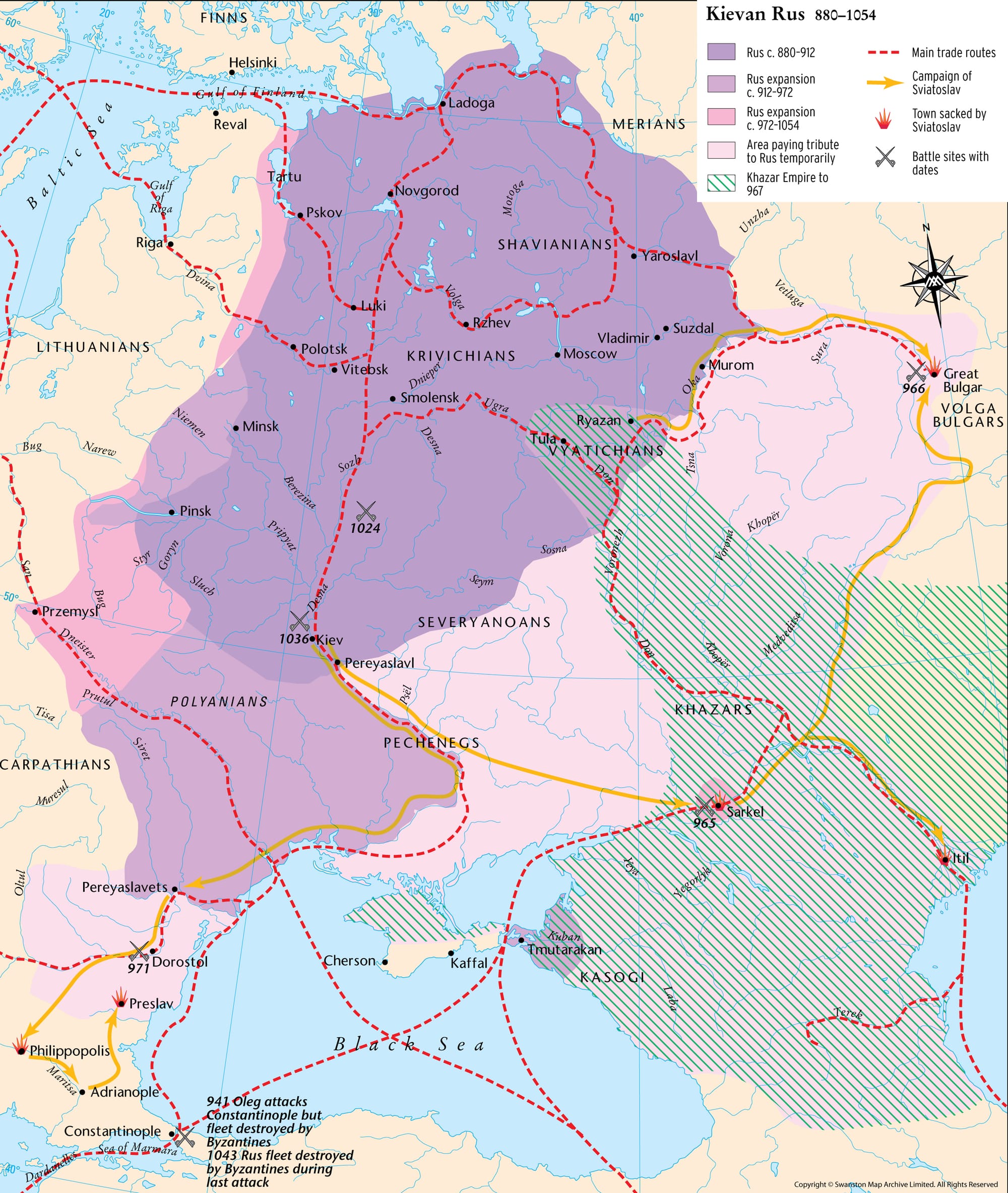
Left: Europe in 1000 C.E. Source: The Map Archive. Right: Kiev Rus. Source: The Map Archive.