“Countless Shops Filled with Diverse Goods”: Introducing the First Global Economy
What do paintings reveal about Portugal’s role in the First Global Economy?

Since my most recent visit to Lisbon, I’ve been thinking about how we can better teach the development of the global economy. Popular historians often glorify the Portuguese or the Spanish for single-handedly creating the first global economy by “conquering the Indian Ocean” (by the way, the Portuguese never did so) or by Columbus “discovering the Americas” (another problematic myth). These popular explanations overemphasize a single cause of the first global economy. The overemphasis on monocausal explanations is not only a Eurocentric tendency. While researching this series on the first global economy, I found resources crediting the Chinese for the first global economy. They also weren’t solely responsible.
I understand the popularity of monocausal explanations for complex historical phenomena; they’re easy for readers to understand. I suspect most high school world history teachers would rather focus on one simple narrative than explain the complexities of how multiple factors contributed to the development of the first global economy. While monocausal explanations might be easier for students and teachers, they don’t make for good world history.
When I began teaching world history, I was lucky that Robert Marks published the first edition of The Origins of the Modern World: A Global and Environmental Narrative from the Fifteenth to the Twenty-First Century. (The book is now in its fifth edition.) In his introduction, Marks concisely explained the importance of historical contingency, accident, and conjuncture. These three concepts are critical to developing global and inclusive world history narratives. He clearly explains conjuncture in a way that can help students and teachers:
A conjuncture happens when several otherwise independent developments come together in ways that interact with one another, creating a unique historical moment… things happening in different parts of the world for reasons having to do with local circumstances that then became globally important.
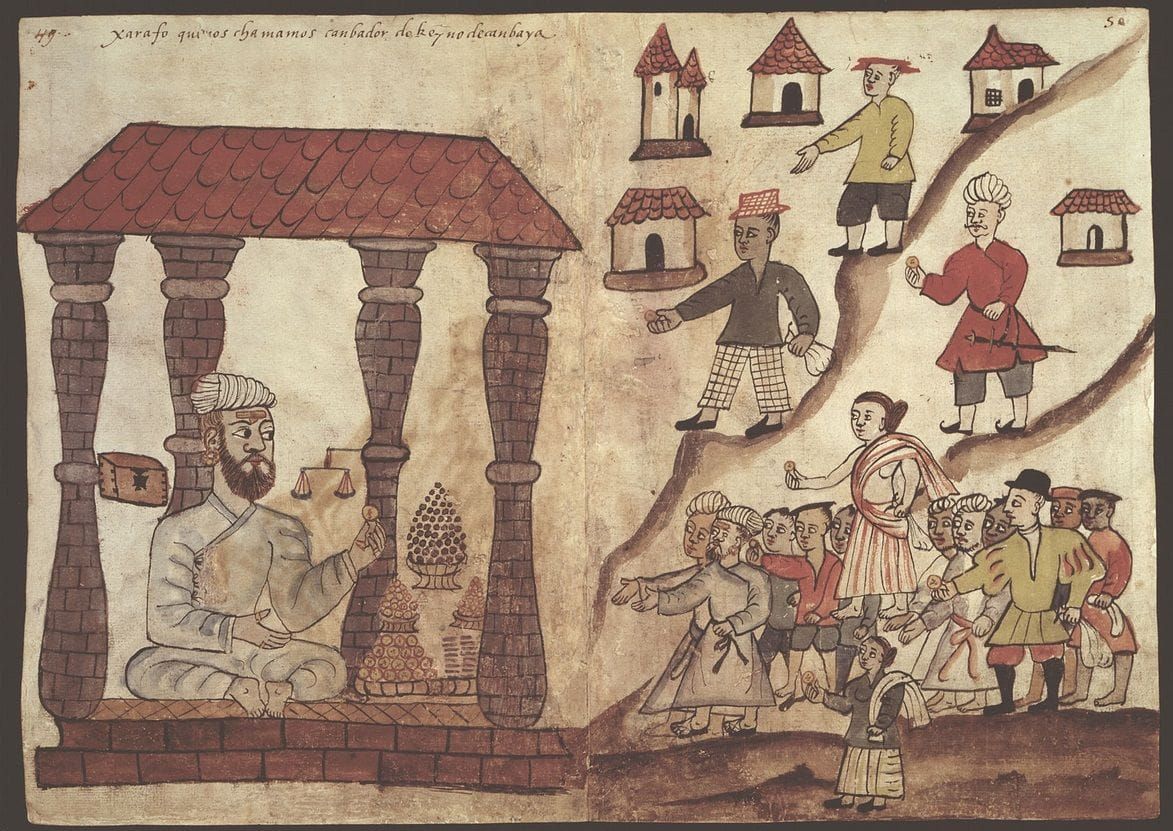
Over the next couple of months, I plan to focus on teaching the global economy in a way that highlights its global origins. When we show students how many different developments occurred around the world between 1450 and 1750 that contributed to the emergence of a global economy, we can help students better understand our long history of global interdependence and how people from all over the world, not just from one region, contributed in meaningful ways to the globalized world we live in today. Using three different “paintings” from the second half of the sixteenth century, we can see both the extent of Portuguese trade and their dependence on Africans and Asians.
In Lisbon
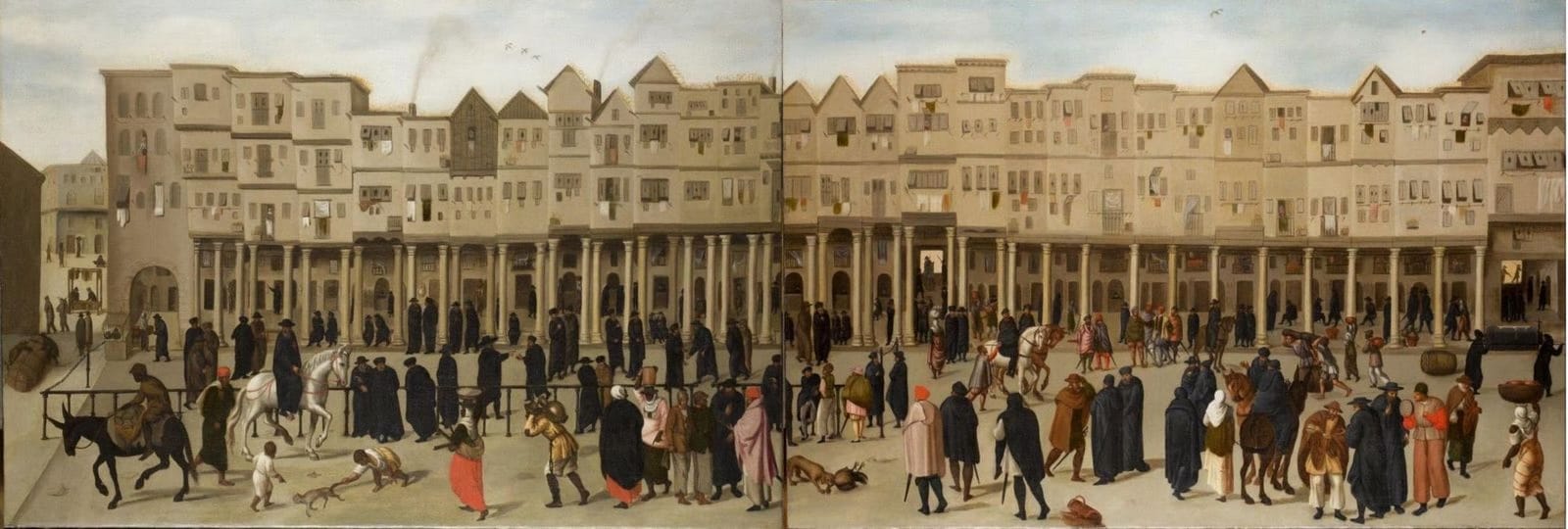
While I began by downplaying the overemphasis that popular historians have placed on the Portuguese in bringing about the first global economy, I still want to begin in Lisbon. And more specifically, I want to begin with one street in sixteenth-century Lisbon: the Rua Nova dos Mercadores (the New Street of Merchants). I’ve previously written about the street and the unique painting that captures it in the late sixteenth century. We don’t know the specific painter, but we do know a Flemish painter made it in the 1580s.
The Rua Nova showcased the new and extensive global connections in Lisbon. In this painting, we can see the extensive ethnic diversity of people in Lisbon. Various skin tones appear in the painting. People also wear a wide range of clothing. We can even see animals from the Americas and Africa. This painting is an excellent resource for introducing the first global economy to students since it shows how new overseas trade connections transformed European cities, such as Lisbon.